 LAMPTOP PACKAGING MANUFACTURING CO., LTD.

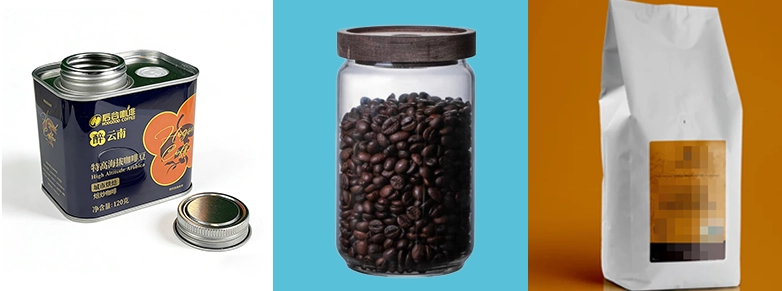
Coffee Bean Packaging Ultimate Showdown: Tinplate Can VS Glass Jar VS Pouch
Why Professional Roasters Are Switching to Tins with One-Way Valves
Data sources: Packaging material performance test reports, consumer survey data, 2025 industry standards
A Decision That Affects Coffee Flavor
After coffee beans are roasted, time is the enemy of flavor.
Every second, coffee beans are losing aroma and oxidizing. Choosing the right packaging directly determines:
- How long your coffee beans stay fresh on the shelf
- Your brand’s professional image in consumers’ minds
- Your cost per cup and profit margin
This article will comprehensively compare three mainstream coffee bean packaging options from a professional data perspective: tinplate cans (with one-way valve), glass jars, and composite pouches, helping you make the best procurement decision.
Core product parameters preview: The data in this article is based on the LAMPTOP 120g tinplate coffee bean can —— dimensions 96×70×90(H)mm, with one-way degassing valve, food-grade tinplate material. (https://tincanbox.net/product/wholesale-coffee-tins-food-grade-custom-printed-canisters/)
Chapter 1: Why Is Coffee Bean Packaging So Special?
1.1 Le “Breathing” Characteristics of Coffee Beans
After roasting, complex chemical reactions occur inside coffee beans:
- Continuous release of carbon dioxide (CO₂): Freshly roasted beans release gas most vigorously within 48 hours of roasting, and this release continues for several weeks.
- Oil oxidation: Exposed to oxygen, the aromatic oils in coffee beans oxidize rapidly, producing a “stale” taste.
- Hygroscopicity: Coffee beans easily absorb moisture from the air, causing flavor loss.
Key conclusion: Coffee beans require a special packaging that “allows gas release while blocking oxygen” — which is precisely the value of a one-way degassing valve design.
1.2 Performance Comparison of Three Packaging Materials at a Glance
| Performance Dimension | Tinplate Can (with valve) | Glass Jar | Composite Pouch (with valve) |
| Oxygen Barrier | ★★★★★ | ★★★★ | ★★★ |
| Light Protection | ★★★★★ | ★ (clear glass) | ★★ |
| CO₂ Release Capability | ★★★★★ (one-way valve) | ★ (requires manual opening) | ★★★★ |
| Compression/Impact Resistance | ★★★★★ | ★ | ★★★ |
| Weight (120g capacity) | ~30g | ~110g | ~5g |
| Reusability | ★★★★ | ★★★★★ | ★ |
| Effective Freshness Retention Period | 45-60 days, 90%+ flavor retention | 15-25 days (significant flavor loss) | 7-15 days |
| Recyclability | ~99% | ~90% | Varies by material |
| Consumer Preference (first purchase) | Function-oriented | Quality/reusability-oriented | Convenience-oriented |
Weight data source: European Packaging Material Comparative Study
Chapter 2: Tinplate Can — Professional-Grade Coffee Freshness Solution
2.1 Core Advantage: Le “Breathing” Technology of the One-Way Valve
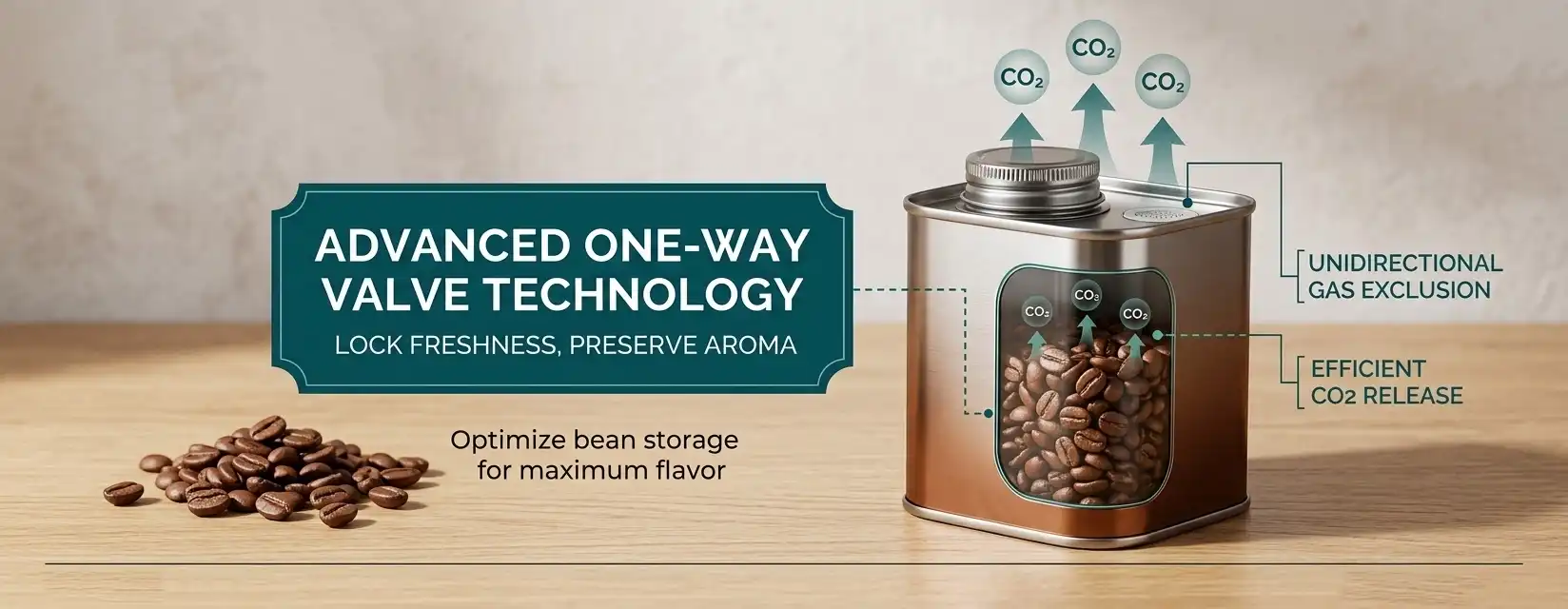
The one-way degassing valve technology used in LAMPTOP coffee bean cans is key to professional coffee packaging:
Working principle: When the CO₂ pressure inside the can reaches a set value, the valve automatically releases gas outward; when the pressure inside the can decreases, the valve automatically closes, preventing external oxygen from entering.
Core pain points solved:
- ❌ Problem with regular sealed cans: CO₂ cannot escape, pressure builds up inside the can, potentially causing can deformation and accelerating flavor loss.
- ✅ Tin can with valve solution: CO₂ is automatically released while oxygen and moisture are blocked, forming a double freshness barrier.
2.2 Physical Performance Advantages of Tinplate Material
- Industry-leading barrier properties
Tinplate cans outperform any other packaging material in gas barrier, moisture resistance, light protection, and aroma retention. The three things coffee beans fear most — oxygen, humidité, and light — tinplate cans block them all perfectly.
- High mechanical strength, suitable for transport
Tinplate cans have high strength, good rigidity, and are not easily broken. For cross-border e-commerce or long-distance transportation, this is an advantage glass jars cannot match — 65% of consumers cite “easy to break” as the main disadvantage of glass jars.
- Fast heat transfer (from a sterilization perspective)
From a food processing perspective, the thermal conductivity of tinplate is approximately 60 times that of glass. This means tinplate cans are far more efficient than glass jars in processes requiring high-temperature sterilization.
- Obvious lightweight advantage
For the same capacity, the weight of a tinplate can is approximately 1/4 that of a glass jar. This has a significant impact on freight costs.
2.3 Specific Protective Effects on Coffee Beans
| Threat Factor | Protective Effect of Tinplate Can |
| Oxygen Oxidation | Sealed structure + valve closes to block oxygen, effectively delaying oil oxidation |
| Light Damage | Completely opaque, prevents UV rays from breaking down aromatic compounds |
| Physical Impact | Metal structure resists compression and impact, extremely low transport breakage rate |
| Moisture | Excellent moisture resistance, keeps coffee beans dry |
| CO₂ Accumulation | One-way valve automatically releases gas, preventing flavor from being “stifled” |
2.4 Value from the Consumer’s Perspective
- Réutilisable, continuous brand exposure
Tinplate cans have a high rate of secondary use after being emptied. Consumers use them to store other items, keeping your brand logo visible in their homes.
- Exquisite printing, enhances product premium
Tinplate surfaces have excellent printability, enabling offset CMYK full-color printing, metallic inks, gaufrage, and other effects. The packaging itself is a marketing tool.
- Respectueux de l'environnement et recyclable
Tinplate has a recycling rate of approximately 95%, is 100% recyclable, and aligns with global environmental trends.
Chapter 3: Glass Jar — An Option with Equally Obvious Pros and Cons
3.1 Advantages of Glass Jars
- Transparent and visible — consumer preference for “quality perception”
Consumer surveys show glass jars have the highest selection rate at the time of first purchase (8 chose glass vs 6 chose tinplate). The main reasons include:
- Transparency allows consumers to visually see bean quality
- Glass conveys a perception of “natural material” et “high quality”
- Strong reusability
- Chemical stability
Glass is stable in nature and does not chemically react with food — this is its core advantage.
3.2 Disadvantages of Glass Jars (Data Supported)
- Slow heat transfer — low sterilization efficiency
The thermal conductivity of tinplate is approximately 60 times that of glass. In scenarios requiring heat sterilization, glass jars require longer sterilization times, which not only affects efficiency but may also have additional effects on flavor.
- Heavy weight — high shipping costs
For the same 120g capacity:
- Tinplate can weight: ~30g
- Glass jar weight: ~110g
The weight difference is nearly 4 times — the difference in quantity per shipping container is substantial, and the difference in freight costs for international shipping is significant.
- Fragile — transport losses
Consumers explicitly cite “fragility” as the main disadvantage of glass jars. Breakage rates in e-commerce shipping and losses in warehousing are practical costs that need to be considered.
- Poor light protection — fatal for coffee beans
Regular clear glass jars provide no light protection whatsoever. Light (especially UV and some visible light) accelerates the oxidation and photochemical degradation of coffee oils, which is fatal for coffee bean flavor preservation.
- Sealed but unable to release gas
Glass jars typically use airtight lids (such as screw caps or rubber ring seals). While they seal well, they cannot solve the problem of CO₂ accumulation. Without manually opening the lid to “burp” the jar, pressure inside the jar will continuously increase.
3.3 Suitable Scenarios for Glass Jars
| Scenario | Suitable? | Reason |
| High-end retail display | ✅ Suitable | Transparent and visible, intuitively shows bean quality |
| Short-term home storage | ✅ Suitable | Consumers can buy small quantities and use quickly |
| Long-term warehousing/transport | ❌ Not suitable | Heavy, fragile, does not block light |
| Export/cross-border e-commerce | ❌ Not suitable | High transport breakage risk, high shipping costs |
| Specialty coffee preservation | ⚠️ Requires light protection | Must use brown glass (but at higher cost) |
Chapter 4: Composite Pouch — Lightweight but Insufficient Freshness Preservation
4.1 Advantages of Pouches
- Lightest weight
A 120g capacity pouch weighs only about 5g, resulting in the lowest shipping costs. - Lowest cost
Pouches are the lowest unit cost option among the three. - Pouches with one-way valves
Some high-end coffee pouches are also equipped with one-way degassing valves, making them superior to regular sealed cans in terms of CO₂ release.
4.2 Disadvantages of Pouches
- Poor compression resistance
Coffee beans are easily crushed during transport, affecting the integrity of the final product. - Does not block light
Common composite pouches typically do not block light or have limited light-blocking layers (aluminum foil pouches block light but are not transparent). - Difficult to reuse
Once opened, pouches are difficult to reseal to their original level, and consumers typically discard them directly. - Difficult to recycle
Composite pouches are made of multiple layers of material (e.g., PET/AL/PE), making them extremely difficult to recycle. Most end up in landfills or incineration. Consumers explicitly cite “not environmentally friendly” as a main disadvantage of pouches. - Poor brand display effect
Pouches struggle to achieve the premium visual effect of tin cans or glass jars and are easily overlooked on store shelves.
Chapter 5: Procurement Decision Guide — Which Should You Choose?

5.1 Decision Matrix
| Your Business Scenario | Recommended Packaging | Reason |
| Specialty coffee brand, pursuing freshness preservation | Tinplate can + valve | Best freshness combination: light block + oxygen barrier + gas release |
| High-end retail, showcasing bean appearance | Glass jar (brown) | Transparent and visible, but requires light protection and attention to transport |
| Lightweight/trial/promotional giveaway | Composite pouch (with valve) | Low cost, light weight |
| Cross-border e-commerce/export | Tinplate can + valve | Compression-resistant, lightweight (compared to glass), unbreakable |
| Long-term warehousing/wholesale | Tinplate can + valve | Airtightness, compression resistance, stackable |
| Eco-friendly brand positioning | Tinplate can | ~95% recycling rate, 100% recyclable |
5.2 Comprehensive Cost Comparison (based on 120g capacity)
| Cost Item | Tinplate Can (with valve) | Glass Jar | Composite Pouch (with valve) |
| Unit packaging cost | Medium | Medium-low | Low |
| Mold cost | Oui (one-time) | None or low | None |
| Transport cost (weight impact) | Medium | High | Low |
| Warehousing efficiency (stackability) | High | Medium | High |
| Transport breakage cost | Extremely low | High | Medium |
| Brand premium capability | High | High | Low |
| Comprehensive long-term cost | Lowest | High | Medium |
5.3 Foire aux questions
Q1: Are tinplate cans with valves much more expensive than regular tinplate cans?
A: The valve does add some cost, but relative to the freshness preservation value of the coffee beans themselves, the ROI on this investment is extremely high — it directly determines the quality condition of the coffee beans when they reach the consumer.
Q2: Which packaging do consumers prefer?
A: Consumer surveys show that at the time of first purchase, glass jars are chosen more often due to “high-quality perception” et “reusability.” However, for subsequent purchases, many consumers choose pouch “refills” to pour into their glass jars for reuse. This indicates that the combination strategy of tin can/glass jar as the “first purchase packaging” and pouches as the “refill packaging” has been proven effective in the market.
Q3: Will tinplate cans rust?
A: High-quality tinplate cans use food-grade tin coating. The tin layer is uniform and dense, providing good corrosion resistance. LAMPTOP products are FDA/SGS certified, ensuring safety and reliability.
Chapter 6: Why Choose LAMPTOP’s Tinplate Coffee Bean Cans?
6.1 Product Parameters
| Item | Spécification |
| Brand | LAMPE |
| Matériel | Food-grade tinplate |
| Capacité | 120g (café en grains) |
| Dimensions | 96 × 70 × 90(H) mm |
| Core Feature | One-way degassing valve on top |
| Quantité minimale de commande | Negotiable |
| Impression | Glossy/matte varnish, huile de perle, through-iron, gold oil, engraved lettering |
Product link: https://tincanbox.net/product/wholesale-coffee-tins-food-grade-custom-printed-canisters/
6.2 LAMPTOP’s Differentiating Advantages
- Dust-free food-grade workshop: Meets the highest hygiene standards for food packaging
- Fully automatic tin can production line: High production efficiency, stable quality
- Fully automatic can airtightness testing: Excellent airtightness preserves coffee bean freshness
- One-stop service: From mold design to mass production, fully controllable
- Global export experience: Products exported to 40+ countries including Europe, America, and Japan
6.3 Take Action Now
Get your customized solution:
- 📞 Contact us for free sample testing
- 📧 Send inquiries to: tincanbox@163.com
- 🌐 Visit our website: https://tincanbox.net/
Conclusion
The choice of coffee bean packaging is essentially an investment in freshness.
Tinplate cans (with one-way valves) perform well across four dimensions — freshness preservation, transport safety, environmental friendliness, and brand display — making them especially suitable for quality-focused specialty coffee brands and cross-border businesses. Glass jars have unique advantages in “visual display,” but the issues of high shipping costs, fragility, and lack of light protection cannot be ignored. Pouches, while lightweight and cheap, perform the weakest in freshness preservation and environmental friendliness.
The most economical solution is often not the one with the lowest unit price, but the one with the lowest comprehensive cost.
For coffee bean packaging, this means: choosing packaging that maximizes coffee bean quality preservation, minimizes transport losses, and simultaneously enhances brand value.
LAMPTOP’s 120g tinplate coffee bean can with one-way degassing valve is a professional choice designed based on this philosophy.